Immigration Alert: DHS Rule Postponed
Updated September 15, 2026
The DHS rule that was scheduled to take effect on September 15, 2026 has been postponed as a result of a nationwide court injunction issued on September 14, 2026. All current F-1/J-1 regulations remain unchanged while litigation continues.
OGS is closely monitoring the developments regarding this rule. Because the situation remains subject to ongoing legal and regulatory developments, we will continue to monitor the matter and provide updates as new information becomes available. This page will be updated as new information becomes available.
Visa Interview Appointments Must Be Scheduled in Country of Residence or Nationality
Effective September 6, 2025, all applicants for F/J nonimmigrant visas must schedule their visa interview appointment at a U.S. Embassy or Consulate in their country of nationality or residence.
What is an F-1 Visa?
The F-1 visa is a nonimmigrant, student visa that enables international students to request entry to the U.S. to study in full-time degree programs. The F-1 visa is an entry document, and must be valid on the date that the student is entering the U.S.
F-1 Visa Application Process Overview
For comprehensive information about the F-1 student visa application process, please visit the U.S. Department of State website.
The following steps make up the F-1 visa application process:
- Be admitted to and confirm your enrollment in an F-1 eligible program at Northeastern University
- Request and receive a Form I-20 from the Office of Global Services (OGS)
- Pay the I-901 SEVIS fee (not required for SEVIS Transfer students)
- Submit the DS-160 visa application and pay the associated fee
- Schedule and attend your visa interview
- Receive your F-1 visa
- Plan travel
- Arrive in the U.S.!

The timeline for the entire F-1 visa process from start to finish can vary widely based on available visa appointments and other factors. Students are encouraged to start the process as soon as possible. In general, it is recommended to allow at least 2-3 months from the time of confirming enrollment to receiving an F-1 visa. F-1 visas can be issued up to 365 days before the program start date.
The U.S. Department of State has published estimated Global Visa Wait Times on their website.
No assurances regarding the issuance of visas can be given in advance. Therefore, final travel plans or the purchase of non-refundable tickets should not be made until a visa has been issued. After the visa has been issued, please be sure the F-1 visa stamp in your passport is accurate and that your original I-20 has been returned to you as you will need to have it in hand when entering the U.S.
Note: Citizens of Canada and Bermuda do not need to apply for an F-1 visa but they are required to have the I-20 and pay the SEVIS I-901 fee before entering the U.S. to study.
Required Documents for F-1 Visa Application
The following documents are typically required for the F-1 visa application:
- Online Nonimmigrant Visa Application Form (DS-160) confirmation page
- You will have to provide a local address in the U.S. on the application form. If you do not yet have a local U.S. address, you may use the address of your home campus, found on page 1 of your Form I-20.
- For a contact person, you can put the name of the person who signed your I-20. You can find this information under “School Attestation” on your I-20 along with the details listed in the next section titled “Contact Person Information”.
- View more Frequently Asked Questions (FAQs) on completing the DS-160 on the U.S. Department of State website.
- Visa application fee payment receipt (visit the U.S. Embassy or U.S. Consulate website for specific instructions)
- Form I-20 issued by OGS at Northeastern University
- Valid passport (the passport must be valid for at least six months after your date of entry into the U.S.)
- Evidence of financial support (proof of sufficient funds for estimated cost of one academic year)
- This should be the same evidence that you presented for I-20 issuance, and the same funding that you plan to use to pay for your education.
- Student and Exchange Visitor Information System (SEVIS) I-901 fee payment receipt
- A copy of your acceptance letter to Northeastern University
- One photograph (see the U.S. Department of State website for photo requirements)
Be prepared to provide additional information, such as transcripts or diplomas from previously attended institutions, or documents which demonstrate that you intend to return home after your studies.
Dependents will receive their own I-20 with their own unique SEVIS ID to apply for the F-2 visa. Dependents are not required to pay the SEVIS fee.
If you do not have a contact person in the U.S. for the online non-immigrant visa application form (DS-160), you can use the name of the person who issued your I-20, and email address and phone number listed below. If you do not yet have a local U.S. address, you may use the address of your home campus, found on page 1 of your Form I-20.
- Email Address: [email protected]
- Phone Number: 617.373.2310
The F-1 Visa Interview
All visa interviews must be scheduled in the applicant’s country of residence or nationality. In most countries, student visa applicants must appear in person for the visa interview. However, each U.S. Embassy or U.S. Consulate sets its own interview policies and procedures. Students should consult the specific embassy website or call for application instructions. Visit the Website of U.S. Embassies, Consulates, and Diplomatic Missions for a list of embassies/consulates.
Visit the Department of State website for more details about applying for your visa in your country of residence or nationality.
Common Types of F-1 Visa Interview Questions
During your F-1 visa interview, you will meet with a consular officer for a few minutes, and you may be asked questions about your studies, your university choice, how you are planning to pay for your education, your post-graduation plans, and more.
The officer will want to see that you have sufficient English to be successful, that you can clearly demonstrate your intention to go to the U.S. to study, and that you have established ties to your home country (family, jobs, school, property, plans to return home), as the F-1 visa is a nonimmigrant visa.
Be yourself, be honest, answer questions clearly and concisely.
Some commonly asked visa interview questions can be categorized as follows:
Academic Purpose and Preparation
The officer must confirm that you have a genuine, specific educational purpose and that you are academically prepared and likely to succeed in your program.
- Why do you want to study in the United States?
- Why did you choose this university / program / field of study?
- Did you apply to other universities? Why did you choose this one over others?
- What did you study previously? Describe your academic background.
English Proficiency
The interview itself is the primary test. The officer will assess whether your English is strong enough for academic success in the U.S.
- How would you describe your English skills?
- Have you studied in English before?
- Will your courses be taught in English? Are you comfortable with that?
Financial Ability
Officers must be satisfied that you have sufficient and legitimate financial support for the duration of your program.
- How will you pay for your education and living expenses?
- Who is your financial sponsor? What is their occupation and income?
- Do you have any scholarships or assistantships?
Ties to Home Country
The F-1 visa is a nonimmigrant visa. Officers must find that you have strong ties to your home country to demonstrate your intentions to return home after your program of study.
- What are your plans after you finish your degree?
- Do you or your family own property or a business in your home country?
- Do you have a job or career plans waiting for you at home?
- Have you ever traveled outside your home country before? Did you return as expected?
- Have you experienced harm or mistreatment in your country of nationality or last habitual residence?
- Do you fear harm or mistreatment if you return to your country of nationality or permanent residence?
Additional guidance is available in the following resource from NAFSA: 10 Points to Remember When Applying for a Student Visa.
Webinar recordings on relevant topics for incoming international students, including on the I-20 and F-1 visa process, are available on the OGS website: Incoming Students Webinars
Online Presence and Social Media Review in the Visa Application Process
As a part of the F/J visa application process, the U.S. Department of State (DOS) will review the applicant’s social media profiles and online presence. This process is to confirm that applicants do not pose a risk to U.S. national security. As part of this consular process, applicants are required to:
- Disclose all social media identifiers on the DS-160 visa application
- Set their social media profiles to “public” for consular review
You can review the June 2025 DOS announcement of this vetting process here.
This process typically takes place after the visa interview and may take an additional 1-2 weeks. Your visa application may remain in Administrative Processing (see next section) during this time.
Visa Application Outcomes
There are a few possible outcomes for an F-1 visa application, which are described below. Once you know the outcome of your application, please submit the Visa Application Status e-form to OGS. Please note that if you do not receive your F-1 visa prior to the start of your program, you may be advised to defer your admission to a future term.
Congratulations! The majority of F-1 visa applicants are approved. You may be informed in the interview of the approval or after. The consular officer may keep your passport for a period of time to add the visa stamp before returning it to you.
Please submit the Visa Application Status e-form to OGS to report your F-1 visa approval.
Visa applications may be denied for a number of reasons, including insufficient information, ineligibility for the visa category sought, or grounds of inadmissibility under U.S. law. In most cases, applicants are notified of the specific legal basis for their denial, though consular officers are not required to share detailed explanations.
You can learn more about visa denials on the Department of State website.
If your visa application is denied for any reason, please submit the Visa Application Status e-form to OGS. You will not receive a response to this e-form, so if you need support from OGS, please contact OGS by calling +1-617-373-2310 or submitting an Inquiry Form in the OGS Service Portal.
Below are two examples of visa denials that students may encounter.
214(b) Denial
A 214(b) denial typically means that the consular officer was not convinced that the applicant intends to return home after completing their studies. To satisfy this requirement, applicants must demonstrate strong ties to their home country, such as family, employment, property, or ongoing education, that make it clear they do not intend to permanently immigrate to the United States.
If your F-1 visa application is denied under 214(b), you should request documentation of the denial from the consular officer. Most individuals are eligible to apply again for the F-1 visa, but you should be prepared to present new information that addresses the previous concerns with your potential immigrant intent in order to overcome the previous denial.
Please be advised that when an F-1 visa applicant receives a denial under 214(b), Northeastern and OGS are typically not able to intervene or provide additional documentation to overcome the denial.
PP 10043 Denial
Presidential Proclamation (PP 10043) suspends F and J entry to the U.S. for certain Chinese nationals applying for study or research that implement or support China’s “military-civil fusion strategy”. This includes those who have been funded by, employed by, or are associated with such entities. The U.S. Secretary of State determines which entities fall under this proclamation.
Currently, the proclamation does not apply to undergraduate students or F-1 individuals already in the U.S. on F or J visas. However, it does allow for future visa reviews and possible revocations.
If you received a denial due to PP 10043, please contact OGS by calling +1-617-373-2310 or submitting an Inquiry Form in the OGS Service Portal. You will be instructed to share the denial notice with OGS for further review and guidance.
Students should review the Department of State website for more information and guidance about visa denials.
The outcome of some F-1 visa applications is a refusal under 221(g) or what is commonly referred to as “Administrative Processing.“ Administrative Processing decisions may take several days, weeks, or months. Please note that this is not a visa denial. You should follow the instructions listed on the 221(g) notice and provide any requested information or documentation to the embassy.
If the 221(g) requires any information directly from Northeastern, please contact OGS by calling +1-617-373-2310 or submitting an Inquiry Form in the OGS Service Portal. You will be instructed to share the 221(g) notice with OGS for further review and guidance.
Additional Information about “Administrative Processing”?
After completing your visa interview at a U.S. Embassy or Consulate, your application might be subjected to Administrative Processing. This involves detailed security checks by the U.S. Department of State (DOS) and other federal agencies. Various factors can lead to this additional review, including but not limited to:
- Social media review
- Your country of birth or citizenship
- Academic or employment history, including military experience
- Travel history
- Source of funding
- Past U.S. immigration records
- Family members’ backgrounds, such as birthplace, work, education, or travel history
- Current U.S. law enforcement priorities related to your country of citizenship or residence
- Geopolitical factors
In many cases, the extended processing isn’t specific to an individual but reflects broader assessments of certain countries or academic fields.
Unfortunately, processing times can vary greatly. If your application is flagged for Administrative Processing, it is forwarded to DOS in Washington, DC for further review. At this stage, the Embassy or Consulate no longer has jurisdiction over your case. DOS then wait for DOS to complete the review. DOS also collaborates with other U.S. government agencies before authorizing the Embassy or Consulate to issue a visa.
Most cases are resolved within one to six weeks of the visa interview, but some may take longer. During this period, neither the student, the Embassy/Consulate, nor OGS can expedite or influence the process.
Next Steps During Administrative Processing
If you have not received an update 90 days after your visa interview, it is advisable to email the U.S. Embassy or Consulate to inquire about your case. After this initial follow-up, continue reaching out to the Embassy or Consulate every 30 days to check on the status. Keep OGS informed of your situation throughout the process.
Please refer to the Department of State website for more detailed information about visa refusals and administrative processing.
Expedited Visa Appointments
U.S. Consulates may be able to expedite an applicant’s F-1 visa interview date if their I-20 program start date is within 60 days, and there are no available visa interview slots prior to the I-20 start date.
The process to request an expedited F-1 visa interview varies by location. You should refer to the instructions on the website of the Consulate where you will interview, or on their online appointment scheduling site. You will need to provide proof of the need for an earlier appointment (such as your I-20 showing a program start date within 60 days).
OGS is not able to assist with expedited visa appointments.
Please note: You must first submit the online visa application form (DS-160), pay the application fee, and schedule the first available interview appointment. Only at this point will a consular section consider your request for an expedited appointment.
Your Visa Stamp
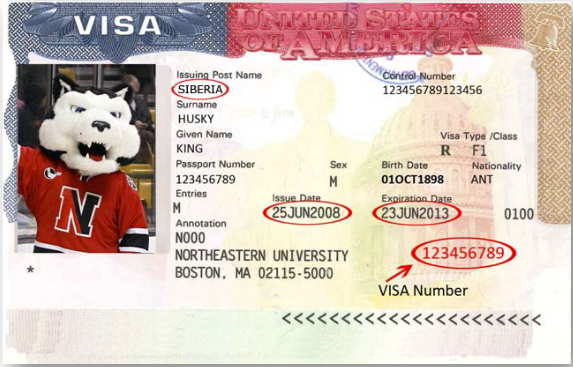
You can request to enter the U.S. in F-1 status between the Issue Date and Expiration Date on the visa stamp, provided:
- You also have a valid I-20 with an end date in the future
- You are requesting to enter the U.S. no more than 30 days before the Program Start Date of an Initial I-20
- You are requesting to enter the U.S. no later than the Program End Date on your I-20, unless you have Post-Completion Optional Practical Training (OPT) or STEM OPT Authorization and a valid OPT or STEM OPT Employment Authorization Document (EAD).
If the section “Entries” has an “S” – that stands for “Single” and means you can only use the visa to enter the U.S. once. If it has an “M” (much more common) – that stands for “Multiple” and means you can enter the U.S. as many times as needed before the visa’s expiration date, provided you also have a valid I-20.
Depending on the length of your academic program, your F-1/J-1 visa may expire while you are still enrolled at Northeastern University, or while you are working on Post-Completion OPT/AT. It is important to understand what an expired visa does and does not affect.
- Your F-1/J-1 visa is an entry document, not a status document. It must be valid when you enter the U.S., but does not determine your eligibility to remain in the U.S..
- Your visa may expire during your time at Northeastern. This has no impact on your legal status or your ability to complete your degree.
- As long as you are maintaining your F-1/J-1 status and have a valid I-20/DS-2019, you may remain in the U.S. after your visa expires.
- You only need to renew your visa if you plan to travel internationally and your visa has expired, whether during your academic program, OPT/STEM Extension, or Academic Training period.
- It is not recommended to travel solely for the purpose of visa renewal, as processing delays could prevent you from returning to campus in time to maintain full-time, on-ground enrollment.
If you renew your passport, travel with the new passport and old passport that has the valid visa stamp.
Entering the U.S.
F-1 student visa holders with an Initial I-20 may request entry to the U.S. no more than 30 days prior to the program start date the I-20.
F-1 student visa holders with a Transfer Pending I-20 or a Change of Degree Level (CDL) I-20 are not subject to the 30-day restriction on entry.
For more information about traveling to the U.S., documents to carry when entering the U.S., and more, please visit the Arriving in the U.S. OGS webpage.